Rising Sun Inn, Darfield
A former pub near Barnsley to be knocked down:

The name of this former South Yorkshire pub was difficult to ascertain. No mention of it on historic maps of the area, I eventually came across a match on closedpubs.co.uk. Darfield History Society also have some interesting pictures and information on their Facebook page.
Perhaps the most dilapidated building I’ve written about, but still worth a mention before it returns to the ether, The Rising Sun was a fine example of staggered terraced building, navigating a steep hill and punctuating a junction. Much of Darfield was cleared in this area in the not-so-golden era of town planning, but this pub remained well patronised even until 1988, as evidenced by this interesting video.
How I wish this little row had weathered the course of time. The optimist in me says a good portion of the building is repairable, but I know only a visionary would be willing to plough money into such a project. I’m sure they are out there. If only they would read my blog.
The Mayflower, Austerfield
Plans to demolish a pub near Bawtry in South Yorkshire:
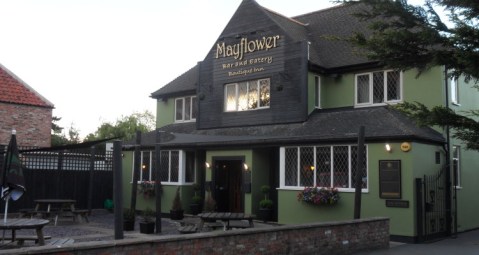
The Mayflower is the only pub on Austerfield High Street. Yet somehow nearby Bawtry supports between 6 and 7 drinkeries. The owners have sunk £300,000 into diversifying the pub and offering a full restaurant service, and the business has yet to cease operating, which suggests the new model is working. Sadly it must not be as lucrative as 12 apartments.
Thankfully the proposal has generated some column inches locally:
Let’s hope the local Parish council can demonstrate the capacity elsewhere for local housing targets, and deny this unnecessary windfall development.
The Three Horseshoes, Killinghall
Pub to be demolished near Harrogate:
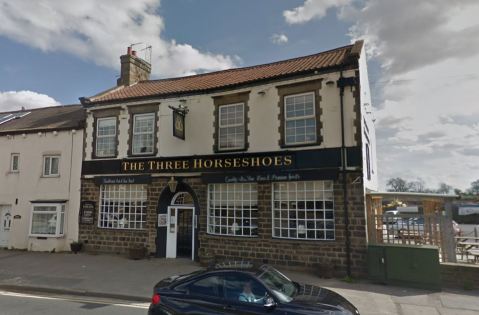
Villages with two pubs are cursed. It seems that one of them must be lost. On this occasion, The Greyhound Inn over the road won out. And again we will see a village lose a dichotomy of alehouses.
From a design perspective. the pub is a vital component of the geometry that makes up the village centre located at the junction of Otley Road and Ripon Road. The building adds vital flare to the street frontage, with bright pantiles, a jet black arched doorway, and exposed window quoins all adding to the landmark quality of this village centre building. If the developer could see the value of this, and then add another building onto the terrace, this would be an enhancement of the village form of Killghall. Undoubtedly the application should be refused on grounds of poor urban design. Please don’t ruin another English village.
Working Man’s Club, Baliff Bridge, Halifax
Application to demolish former Working Man’s Club at Baliff Bridge, Halifax

Most recently this building has functioned as a nursery which closed in 2013, which folded due to unpaid fees. It must have been a stretch for Martin Walsh Architectural services to claim in their Design and Access statement that the removal of this building and replacement by 4 houses would improve the street frontage in this area. Can an architect’s license be revoked?
This is a very interesting building, as it does not appear on maps until 1922, so it was likely erected in the first two decades of the 20th century. Yet the building looks to be 18th century in age, with the narrow coursed stone, mullioned windows, and stone tiled roof suggesting an earlier vintage.
Perhaps this building was constructed from repurposed material? I have not been able to find much information on the history of this building, so if anyone out there knows anything please get in touch.
Queens Hotel, Sheffield
Pub to be demolished in the industrial fridge of Sheffield’s City Centre:
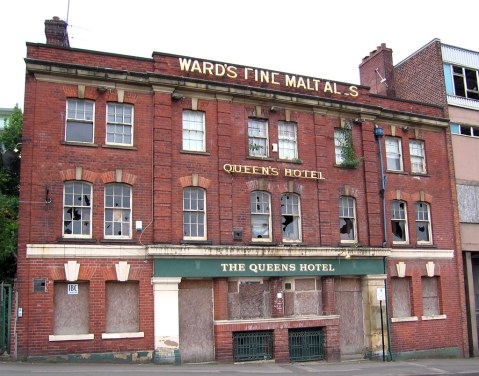
A pub has existed here since 1791 with the current building appearing in 1928. Open and closed through the years, the venue was an integral part of Sheffield’s second-to-none nightlife of the 90s.
As Sheffield’s (rightly much-lauded) urban renaissance continues, Scotland Street will become a key component of inner-city urban life. Not much heritage frontage exists along the street now, and this building would provide some relief from the cladding and brick slips that will predominate the townscape as developments are built out.
Plans to convert into residential accommodation were contemplated a few years ago, so the option is there to retain what is clearly a robust building. I would urge the council to resist demolition on the grounds that the building is vital to regeneration of the area as a townscape heritage asset.
Some interesting photos of the interior, which appears to have been fire damaged, were submitted to 28 Days Later
Former Queen Hotel, Hull
Plans to demolish a series of buildings including the former Queen Hotel in Hull:
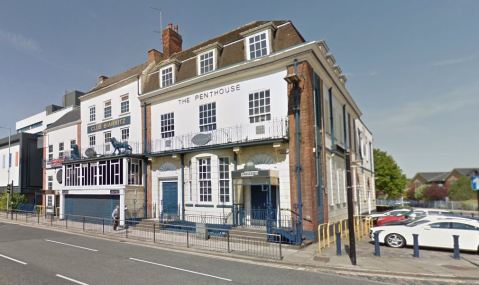
A terrace of three buildings that have variously been used as pubs and nightclubs throughout the years are set to be demolished after a prior notification application went into Hull Council. Plans to convert the buildings into 18 residential flats were approved when Club Valbon finally shut its doors in 2017, however, the owner appears to now have an appetite for destruction.
The beautiful gambrel roof, the balconets, and the well-ordered sash windows bring a rhythm to this street and form an elegant corner in an otherwise anti-urban corner of Hull
The last thing this already harried city needs is more of it’s heritage to be lost. I hope the inevitable new surface carpark that lands here will bring as much joy to Kingstonians as this row of pubs once did.
Article posted on theworldnews.net
The Plough Inn, Crosspool, Sheffield
Plans to demolish the Plough Inn:
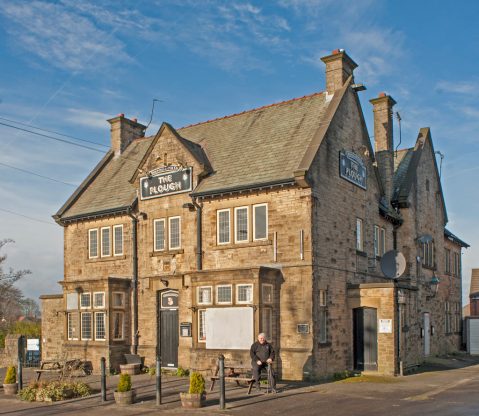
I can not believe this application has even made it past validation. Where to start…
This exceptionally old pub in Sheffield is adjacent to Hallam FC, and local derbies between Sheffield club and Hallam FC would culminate in drinking sessions in The Plough. These happen to be the oldest football clubs in the world. This article in The Star sums up what needs to be said.
How historic does a building have to be? I recently talked about a pub in which the Luddites devised their seditious plans. The Plough Inn was where (gently presses capslock) THE RULES OF MODERN FOOTBALL WERE FORMULATED. This is another level of importance. I’m glad to hear local councillors are fighting to save this building, but disgusted that a developer and attendant consultants could ever consider hatching up a scheme to see this pub off. I hope they are never seen in Sheffield again.
History aside, the building is stunning, and is a viable robust public house. Even if the planning officer is oblivious to the footballing context, this building needs to be saved on its architectural merit alone.
Alma Inn, Wombwell
Application to demolish pub in Barnsley:

Although the roof looks like it has been replaced recently, it looks like this building dates back to the 19th century, with maps from 1892 showing a building of the same footprint not listed as a public house. The spalling on the masonry and general patina also suggest a Victorian provenance.
I’d like to find out a bit more about this building, so if anyone has any info or images of the pub please do share them.
Boars Head, Pudsey
Former pub in Leeds:
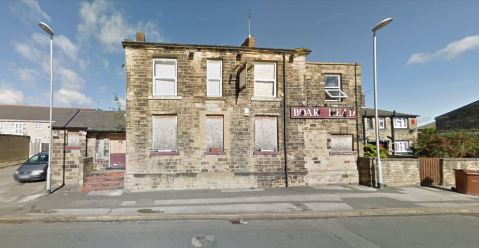
This pub has been derelict since 2003 (google street view from 2009 shows it largely unchanged – a few more letters on the sign than there are now perhaps).
This is the fourth pub to close on this high street, which at one time would have provided a half-decent drag within the Pudseyan nightlife.
The local townscape will be dramatically altered when this building is lost. There is cyclical succession at play in places like this; the old buildings are lost, character is diminished, the area becomes ripe for development, market demands means more old buildings are lost.
Another one bites the dust.
Pubs and clubs this month
A couple of pubs up for demolition in Yorkshire:
Moldgreen Top Club in Huddersfield:
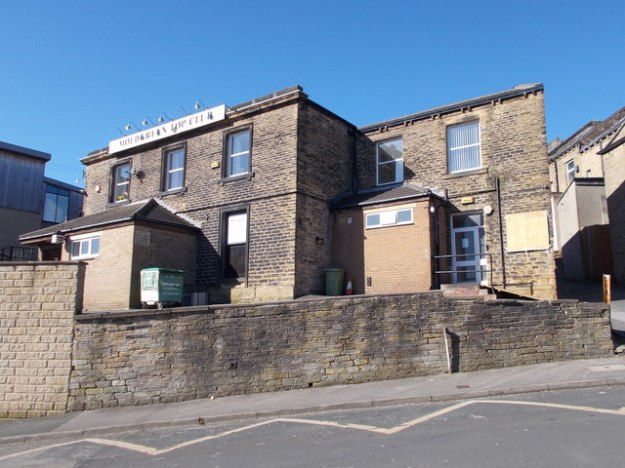
Overlooking the inner industrial suburb of Moldgreen, this former working mens’ club is quite a sharp build, with well-ordered windows on a utilitarian frontage. It could almost be a Wesleyan Church, rotated away from the inclining road, to overlook the Parish below.
It is to be succeeded by 12 apartments. That is quite a quantum for a site of this size. Im sure with a bit of creativity the pub could have integrated in some way into the development. A sad loss indeed.
…and The Magnet in East York:
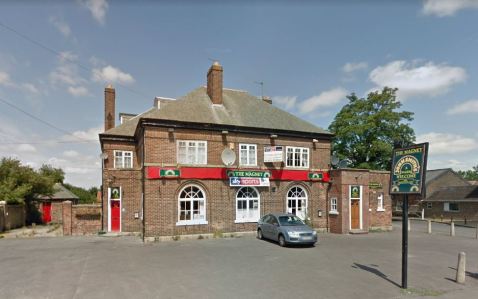
Built in the 1930s, it is another example of what the developer calls a ‘corner beer pub’ in a leafy urban extension. The develop justifies the potential loss stating that “It must be remembered that the pub was built at a time when such facilities were in high demand. Drinking and the associated socialising was one of the few leisure pursuits available” (York Press).
I assure the gentleman, that drinking is as popular as ever. The reality is that the culture of the local has sadly all but disappeared, in tandem with the erosion of society writ large.
 The Demolition Register