Cottage in Central Ripon
Small cottage cum workshop to be replaced with three townhouses:

To be lost is a sweet old building occupying the rear of a burgage plot in the middle of Ripon.
Most would agree that it isn’t really worth a mention, it being a rugged simple brick and beam build. But look closer, and you can spot the nuance that won’t be present it its successor; the roof pitch doesn’t match the adjacent building; the brick is the same as that of the boundary wall; the entrance seems to be neither of the ground floor or first floor.

But from the Architects drafting I’m confident it will be tastefully replaced. Indeed, three new residential addresses down this side street could really breath life into this corner of the city. Still, it will be a long time before we have a new old building here to catch our curious eyes.
ABC Cinema, Wakefield
Demolition notice for an art deco cinema in Wakefield City Centre:
Derelict for 20 years now, it feels as though this cinema has weathered numerous attempts on it’s life over the years. In all honestly I didn’t actually realise it was still standing. Beloved locally to the extent that it has its own Facebook group, demolition is now looking inevitable. All the sake of another surface car park.


It is important to remember that cinemas can only ever be of relatively recent built history, and the small town centre theatres are the first wave of this vital part of modern history. This cinema is of no striking architectural merit, aside from the art deco ordering and rotunda-esque massing. However in terms of social meaning, the arrival of a cinema in Wakefield marks the start of modernity in this provincial city.
And imagine having the civic foresight to actually integrate a cinema building into the existing townscape, rather than building one on the settlement edge, preferably next to a motorway junction, drive through restaurant, and a concrete prairie of car parking.
Easy to convert to a multitude of uses, and no reason to expend a million tons of carbon redeveloping the site. Why not retain it and let the ABC cinema become rightfully historic?
Hollycroft, Ilkley
Edwardian villa threatened with demolition in Ilkley:

A beautiful suburban Edwardian house that has been used until recently as a care home is threatened with demolition following acquisition by Barchester Healthcare Ltd. Although not listed, the building is within a conservation area, an as such this should be grounds for refusal on the harm that would result from its loss. Indeed even the heritage statement acknowledged that ‘ipso facto’ the building is a designated heritage asset.
Pre-application advice from the case officer at Bradford Council stated that the principle of the development is acceptable, effectively giving the go-ahead to the developer before the application has entered the public domain and the democratic due process.
Nonetheless it is reassuring to see the barrage of public comments objecting to this proposal, including objections from Ilkley Town Council who rightly point out that allowing demolition on the grounds that a building is in disrepair effectively rewards owners for neglecting heritage.
After so much opposition, it would be a shock to see this one get permission.
Salem Chapel, Bradford
Application to demolish a church and build an industrial unit:

Above: The Victorian Chapel that has been used as a community centre until 2018.
Below: The grey mass that would replace it

An important church in Bradford is facing demolition to make way for an industrial unit. A few people are to blame for the chain of events that have led to this.
The building is robust, and having been in use until 2018 is clearly a viable property for repurposing. The fact that an application to change the building into retail use went in recently is testament to this. Unfortunately the council refused this application as the area is not designated for retail use in the local plan. They call this zoning and is anathema to British planning.
This would have resulted in the building being retained in perpetuity, but alas Braford Council have put the future of this church in jeopardy. And that is the argument the owner is using to justify its destruction. That refusal means the building cant be sold to a potential retail business.
The comments in ‘support’ of the development concern me. ‘Neighbours’ welcoming the removal of this eyesore (really? a historic Victorian church I an eyesore?), and suggesting this single industrial unit will usher in an industrial renaissance for the city. Lets be honest, these are the developer’s mates. I hope the case officer sees through this ruse.
Salem Chapels were built by independent congregations in various Northern industrial cities and are a fundamental component of Victorian civic development. The equivalent in Leeds in grade II listed. The Leeds chapel dates from 1791. If this chapel is of a similar age, its loss would be criminal.

Calder Mill, Hebden Bridge
Application to clear a site just outside of Hebden Bridge, Calderdale:

Between Hebden Bridge and Mytholm is a valley which has not changed in 150 years. Having cycled down the canal here many times, I can attest to the fact that this is one of the most special places in the country. This valley up in the Pennine hills is a time machine to the industrial revolution.
Sadly Calder Mill was gutted by fire in 2019, and has been deemed unsafe (although the two main factory buildings look unscathed in my opinion) and the site is in the process of being cleared and redeveloped.

The map from circa 1900 shows the area to have been much more built up than it is now. It is a shame that this townscape is being slowly eroded.

The proposal to replacement the mill has made a noble effort at preserving the vernacular, with roofs that take their form from the mill’s north light roof. Yes the speckled stone, the relationship with the street, and the lack of any arches result in a proposal that is somewhat pastiche. Probably the best we could hope for, but another example of why it is impossible to recreate heritage buildings. Hopefully they will develop the damp green patina of the Calder Valley in the next 50 years.
Office building, London Road, Sheffield
Demolition to demolish a high street building in Sheffield:
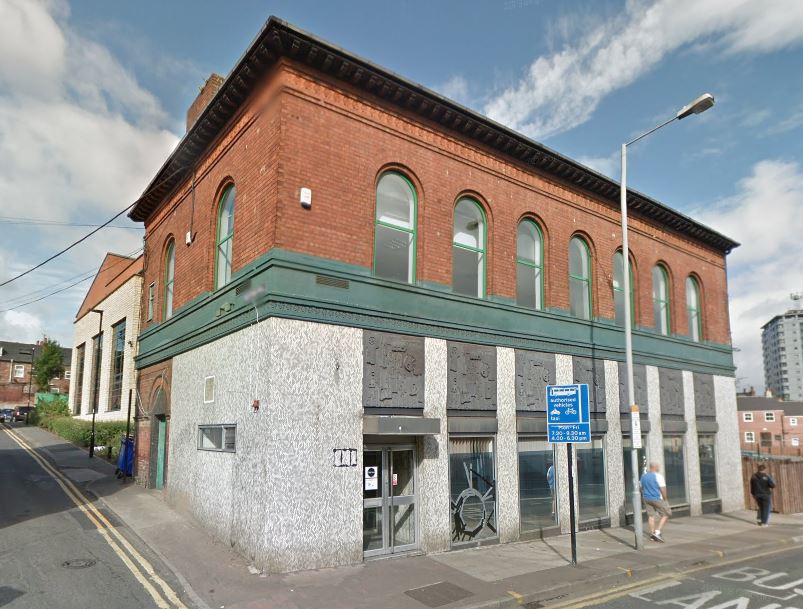
A modest but important part of the street frontage along London Road in Sheffield City Centre, this Victorian building with the painted wooden window trim is exactly the sort of building that urban designers long for. Its frustrating that we are pulling them down.
The application seems to have been withdrawn, but no doubt the applicant is redoubling, making some amendments, before they come in again. The ground floor elevation has been modernised possibly in the 1980s, but behind the mosaic paneling there is likely to be a Victorian pub frontage as per the historic maps:
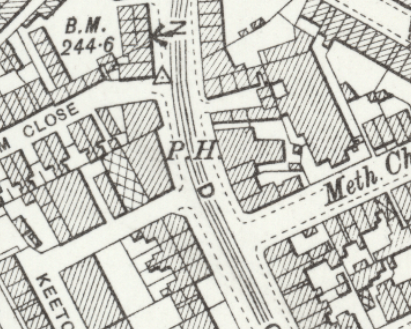
Sheffield has a fascinating city centre. Lets keep it that way and look after its history.
St Mary’s hospital, Leeds, demolished by stealth
Another application to demolish more of the St Mary’s hospital campus in Armley, Leeds:

The iconic principle elevation of the hospital.

A couple of months ago, I posted about another wing of this hospital being demolished. At that time, there wasn’t much remonstration due to the retention of the main hospital building featured here. Now that wing is for the chop, it is clear that the entire hospital is to be lost, incrementally, to avoid drawing the ire of conservationists.
The mental health hospital occupies the former Bramley Union Workhouse of 1862, shown in the map above. The historical importance of this building goes without saying. A stunning building with a beautiful tower capturing the humble elegance so many Victorian public institution buildings imbibe.
No statutory protection results in the demolition prior approval going through the planning system unprotested. In the officers report, the council acknowledge the buildings to be ‘considered to form non-designated heritage assets’. This should be enough to remove PD rights via article 4, and avoid the demolition.
I hazard that this could never happen due to the asset belonging to the local NHS trust, and being part of a wider asset strategy, which will involve selling some land, and down buying sites elsewhere, undoubtedly which has been programmed in for years. Interference from the planning department on such matters is just not the done thing.
And its not as if there is an exponentially increasing demand for mental health services or anything like that.
The Old Mill, Morley
Small Victorian warehouse to be cleared for housing in Morley:

Modest attractive warehouse to be lost on Station Road in Morley. Its hard to appreciate from the image but the street here is quite a dramatic scene due to the levels being so steep. The mix of stone and brick of the townscape complement the leafy green bank. Its a shame a developer couldn’t see value in converting the building to flats, as it is robust and would save a lot of carbon emissions.
Buildings like this usually don’t get a second look, but wouldn’t it be great if at pre-app, the council would encourage the reuse of the building, and make it clear huge amounts of weight in the planning balance would be given to such a scheme.
Sutton Arms pub, Stockton
Pub, demolished without planning permission in Elton:

This pub only closed its doors last September, amidst the moratorium on the hospitality industry. Yet the application has argued that the building was marketed unsuccessfully and that a pub in this location is unviable. Disgracefully, the owners knocked the pub down, in hope that retrospective planning permission will be granted.
The reaction from the residents of Elton is testament to how much this institution meant. Comments have poured in, urging the council to lay down the law and demand the pub is rebuilt brick by brick. This happened in London, so why not Stockton?
A village is left bereft of a place to gather. The building is by no means ancient, having been built in 1900. Yet the half-timbered first floor, bold chimneys, and adjacent phone box create a mise en scene that worthy of every effort to retain. These places can not be found anywhere else in the world.
Sun Inn, Skirlaugh
Second application to knock down historic village pub in East Yorkshire:

An application to clear this site was submitted last year and thrown out on the grounds that the pub is tantamount to a community facility, in spite of it being closed for a number of years.
A brilliant (and rare) determination that responded to the concerns of the villagers and the social fabric of the village. Yet the developer is going in for a second pass, with an application that still involves the wholesale loss of the 200 year old pub.
Social capital aside, the pub adds a lot to the genius loci of the village centre, extending the building line of the village core up Church Lane. And a village the size of Skirlaugh needs two pubs.
Lets hope East Riding development control throw it out again.


