Former Sunday School, Birr Road, Bradford
Demolition of a stunning listed ecclesiastical building:

Another shocking application to denude Bradford of her history. This is the former Sunday school to the rear of Most Holy Trinity & Our Lady of Pochaiv Church in Manningham, and it is a stunning building, which cumulatively with the church forms an almost abbey size Catholic campus in the city.
The plan is to knock it down and get ten houses in there. Needless to say the housing crisis will be cited by the applicant as justification, when the building could clearly accommodate that many flats, with much lower carbon expenditure required.

A YouTube video here does a brilliant walk-around of the building. The structure appears to be sound. Granted, the windows are boarded up and someone has tagged the shutters, but the masonry looks as fresh as the day it was built. The roof also appears to be in order, particularly for a building that hasn’t been in full use for ten years. Then again, churches are built to last. I mean really last – beyond the market forces and council housing strategies of the moment.

There is no reason to demolish this building other than the fact that it would make more money as developable land. But when a building is listed, and in a conservation area, and immediately adjacent the setting of a church, and is consecrated ground (I could go on…) the economic imperative is second to its heritage significance.
How annoying that the Council is being emotionally blackmailed by the notion of enabling development that would subsidise the main church building. I need only mention that the Catholic Church is rolling in it, and doesn’t need subsidising at the expense of a crime against heritage.
I’m also saddened to see the Ukrainian Church supportive of the proposal. I mean no disrespect, but the congregation should not have the final say as putative owners. It may be their church now, but it wasn’t always. This was built for the people of Yorkshire long before and it remains our history.

Royal Oak, Mosborough, Sheffield
A retrospective application (ie. its already happened) to demolish a pub South of Sheffield:

What an egregious way to manipulate the planning system. Tear down a local pub knowing that the law states you need permission for this and then ask for it retrospectively. What can they do? Say no and tell you to rebuild the thing? I highly doubt it.
It means a lot to see the high volume of public comments on the application, also exasperated with this criminal activity. A resident notes that the pub closed during lockdown, and this is grounds for it being described as an unviable business. There was a pandemic I seem to remember.
I would love to see the swines being made to build it back, brick by brick, to specifications set out by a heritage professional. And if their business goes under so be it. You broke the law and you deserve it.
That won’t happen. Despite the public ire the planning officer will want to avoid an appeal and the developer will get their 6 houses built out before the end of 2022.
The last of old Kirkstall Road, Leeds
Application to clear a sit along the old industrial corridor of Kirkstall Road in Leeds:


This site has had a couple of applications approved over the years, all of which have demanded a carte blanche site for the arrival of a few residential towers, The two industrial buildings shown above are part of the dwindling industrial street frontage of Kirkstall Road, which is currently being regenerated in a very anti-urban way. A sequence of isolated towers with no conhesive form are slowly making their way along the arterial corridors of Leeds.
The Dulux decorator centre is asking for a craft ale taproom (Kirkstall Brewery across the road, hint hint), and the street art on the film studio building is an indicator of the cultural presence already here. If you aren’t well versed on modes of heritage led-regeneraton, and don’t understand the value sense-of-place, you are not a very talented urbanist.
A new urban quarter that could be Leeds’ Brooklyn, is likely to become Brookside; buildings clad in the same material, with the same architecture, with absolutely no relationship to the existing context or the indsutrial history.
Was it a pub? Victoria Lodge, Thorne
Application to demolish a house in Doncaster district, which suspiciously looks like an old pub:

In my humble opinion, Thorne is one of Yorkshire’s best-kept secrets. A medieval market town outside of any national park or AONB, it is a paint job and a sourdough specialist away from being Thirsk. Yet even Doncastatrians are at a loss to point it out on a map.
This building is not magnificent, and as far as I can tell was the lodgings for those using the neighboring (former) Victoria Inn, now an Indian restaurant. Whether or not the Victoria Lodge operated independently as a pub is not known to me, and will likely be a secret only the people of Thorne know.
A lovely building in an old part of town, its loss is needless as the development site to the rear is clearly already accessible.

Shown in red on the historical map from circa 1900, no indication that it was a pub at this stage.
Houses in the open countryside
I have come across various rural houses/ex farms that have gone into the planing system for demolition this month. Some of these buildings appear to be truly ancient.

The pair of cottages in Raskelf (one of my fabourite place names) above are set to be replaced with a pair of equally sized and sited deatched houses. A pointless carbon intensive excercise. Why would any Council in the land be ok with that? This farm is being sold off piecemeal via various lots at auction. This could be a new village. Historically, thats how settlements all started.

The converted barn above near Kirby Malzead is due to be replaced with a chimneyless bungalow. Buildings in the open countryside are a componant of the landscape and in this particular case, visible from huge distances. Very sad that no objection from the Parish or any local group has been made.

This beautiful farm house just outside Slathwaite will be demolished and replaced with a new build, which it has to be said is a very sensitive design. Lets hope the planners condition the reuse of materials.
12,14 and 16 Lower Brunswick Street, Leeds
Former joinery works in the Leeds’ Northern Quarter:

Its very difficult to discern what parts of this building re original and what have been replaced. The filletted brick corner shown above appears to be original, but the lack of spalling on the other flank of the building would suggest it was repaired latterly.
Nonetheless, the value of this builing comes from the paucity of the original industrial fabrc left in this quarter of Leeds. Formerly a joinery, the six compacted gables to the roof endow this street with glamour and belie its industrial function. If Leeds has any aspiration for cultural regeneraton, and a ‘quartering’ strategy for its city centre, it needs to hang on these modest yet vital buildings. Last month we saw the final remnants of the historic South Bank dissapearing. This is the same story.
Perhaps the loss of the neighbours (the Synagogue, and iconic The Brunswick Stadium boxing venue) are more lamentable, however they are gone, and as of writing, this is not.
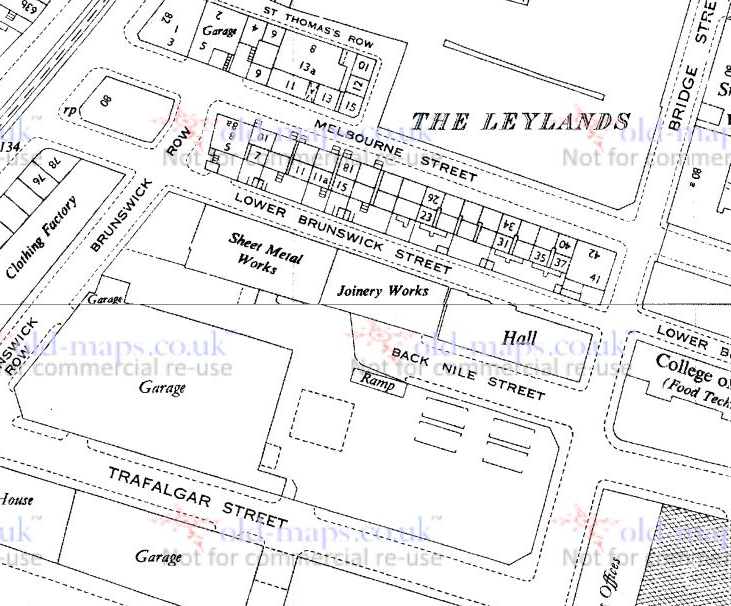
Shown above in 1951 as the joinery works, Lower Brunswick Street was complete. No gaps for surface car parks. A full frontage.
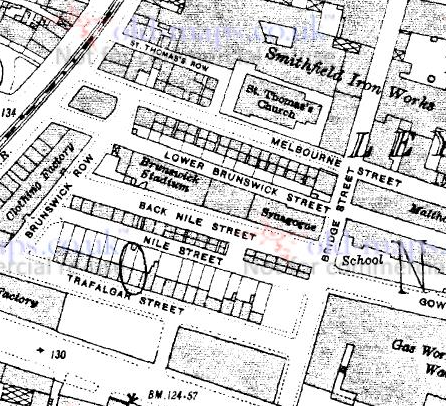
An earlier map from 1933 shows the Synagogue and boxing venue also on this street.
Cross Keys Pub, Spalding Moor
Last pub in the village of Spalding Moor near Hull to be lost:

This received permission last year, and it looks like the demolition is going ahead very soon.
It is always a shame to lose a pub, but when its the only pub, that is tragic. What a boring place this will now be. Moreover, this pub sits on the cross roads in the centre of the village. Its a landmark building. It is the focal point of the settlement. Urban design is not a new science anymore. We know the damage that this type of development and demolition does to a community. There are so many ways a planning officer could refuse this development based on local policy. I know this because I am a planning officer, and there is always a way to make the right thing happen.
St Nicholas Primary School, Beverly
Notification of plans to demolish a school in Beverly:

Yet another Victorian primary school is being sold to a developer for a quick receipt for the council. Developers who lurk around council asset managers waiting for a bargain tend to be somewhat predatory, and are not the type of people to have the scruples that would see the beauty in such a building.
This is a stunning public building, which is still robust and fit for purpose. The variety of gables and the qoin features on the windows bring so much to the townscape here.
And it looks like a school, unlike new efforts at education facilities, which tend to look like a series of boxes adorned with serviceable landscaping and a few rainbow murals.
Hare and Hounds pub, Bradford
Another former Bradford pub to be demolished:

Three pubs have gone into Bradford’s planning system for demolition in August, the other two being 20th century the Generous Pioneer in Burley and The Newby Square on Old Lane (shown below).
This pub in the middle of Eccleshill in Bradford shut a while ago, leaving behind its twin over the road, The Malt Kiln. As I’ve argued many times, the sum of two pubs is far greater than its parts. Two to three pubs is a destination people will travel to.
This is a very attractive Victorian pub with some quirky Bradfordian features. The bay window to the flank provides a natural landmark feature to the junction on which it resides. The extended element with a reverse mono-pitch also adds interest to the street scene. These incidental quirks do not exist in modern buildings.
The application makes no mention of its use as public house, and refers to the ‘demolition and reconstruction’ of the building. The plans show a dull hipped roof box, typical of the urban edge. In design terms, this would be another step backwards by Bradford Council and yet another piece of its stone history lost.


The two other pubs on their way this month. Interestingly, Green King’s The Generous Pioneer (below) is in fact a relatviely new building. A lot of effort went into a historically sensitive building. What a waste to flatten it.
South Bank buildings, Leeds
Application to demolish some of the last buildings on Crown Point Road, Leeds:


It looks like the decade of scaffolding erected to preserve this building until some heritage funding could be found, was in vain after all. About 4 buildings can be found along Crown Street, that are currently constitute the cultural lynchpin of the recently branded ‘South Bank’. The scarcity of the heritage here means those bricks are worth their weight in gold. The map above shows how dense the urban tissue of the area used to be – now generally in use as a series of surface car parks.
Those that don’t know Leeds’ Southbank will wonder what merit there would be in hanging on to these dilapidated buildings. When you consider the entirety of Victorian Leeds south of the River Aire has all but been lost, every last vestige of the industrial past needs to be retained to anchor the space within some historical context. The developer, Vastint (which is actually Ikea) should be aware of the irreplaceable value this adds to development. If the regeneration of the south bank takes place upon a tabula rasa, then it isn’t really regeneration. Its a boring new town.
The building is modest, however it does demonstrate some interesting features, with a hinged front elevation, and stone detailing that makes for an attractive urban building. I don’t know much about the building, and would be curious to know if any readers out there know its previous use, or of previous plans to regenerate it.

